
Understanding the EU Tax Mix: Why U.S. Business Owners Should Pay Attention
As the tax landscape becomes increasingly globalized, businesses and high-net-worth individuals in the U.S.—including those in Maryland, Virginia, and Washington, D.C.—are feeling the ripple effects of tax policy changes across the Atlantic. Among these developments is the evolving EU tax mix, a concept explored in a recent interview between Sean Bray, a transatlantic tax policy expert, and Dr. Irma Mosquera Valderrama, Full Professor of Tax Governance at Leiden Law School and EU Jean Monnet Chair Holder on EU Tax Governance.
While the term EU tax mix may sound like something that only matters in Brussels or The Hague, it has growing implications for U.S. companies with cross-border operations or online customers abroad. Understanding how these policies work—and how they're shifting—can help your business minimize risk, stay compliant, and adapt strategically.
Let's break it down.
Key Takeaways
The EU tax mix refers to the balance of taxation across income, consumption (VAT), and green/environmental taxes
The European Union is shifting toward consumption and environmental taxes, especially to support climate goals and long-term sustainability
U.S.-based companies doing business in the EU—or transacting with EU customers—may face increased indirect tax exposure
Green and digital taxes could become more common globally, influencing corporate tax planning, supply chains, and pricing models
Strategic tax structuring, international entity management, and estate planning may need to be revisited as these changes gain traction
Why This Matters for U.S. Business Owners
Business owners in the DMV region—especially those operating LLCs, S-Corps, or other pass-through entities with global interests—can no longer afford to view international tax policy as someone else's problem. Even if your business doesn't yet have a physical presence in Europe, EU policy decisions increasingly affect American companies through digital services taxes, trade rules, ESG reporting, and more.
Dr. Mosquera Valderrama's insights shed light on a complex but increasingly relevant aspect of global tax planning: how different types of taxes interact and how governments worldwide are rebalancing their tax frameworks to meet emerging priorities.
Let's take a closer look at what the EU tax mix is—and how it may impact your financial and strategic decision-making.
What Is the EU Tax Mix?
In the interview, Dr. Mosquera Valderrama explains the EU tax mix as the combination of three main revenue sources:
Labor and income taxes: Traditional taxes on individuals and businesses
Consumption taxes (primarily value-added tax or VAT): Taxes on goods and services
Environmental or green taxes: Taxes aimed at discouraging activities harmful to the planet
Historically, labor and income taxes accounted for the majority of tax revenue in many EU countries. Even though environmental taxes as a share of total tax revenue have declined slightly in recent years, nations continue to rely on consumption and green taxes. These taxes help governments finance climate-related expenditures while reducing reliance on personal income or corporate tax—areas that are harder to enforce in today's global, mobile economy.
From a policy perspective, the EU is guided by goals like the European Green Deal and the OECD's push for global tax harmonization such as the Pillar One and Pillar Two frameworks. Many of these initiatives aim to close loopholes, encourage sustainability, and create a more transparent tax environment.
How U.S. Businesses Might Be Affected
Even though the U.S. has not embraced a federal VAT or carbon tax, American businesses that sell into the EU or interact with European markets already feel the effects of the EU's evolving tax mix. Here's how:
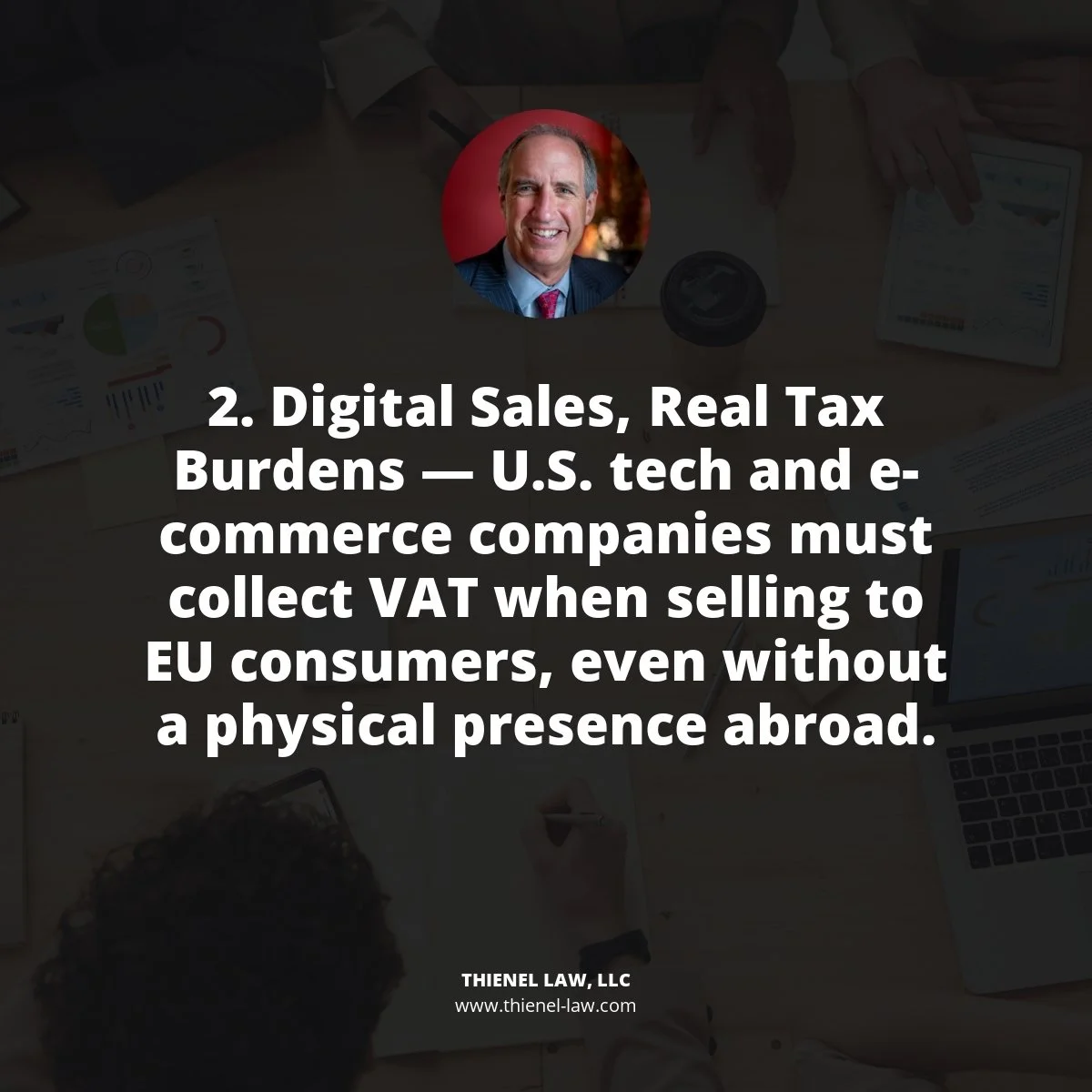
1. Digital Services and VAT Exposure
U.S. tech companies, e-commerce platforms, and digital service providers may be subject to EU VAT obligations even without a physical presence. The EU applies VAT on digital services provided to European consumers, and new rules make foreign sellers responsible for collecting and remitting taxes.
For example, a Maryland-based SaaS company serving customers in France or Germany might be required to register for VAT in those countries, charge the correct tax rate, and file periodic returns. This adds compliance burdens and potential penalties for noncompliance.
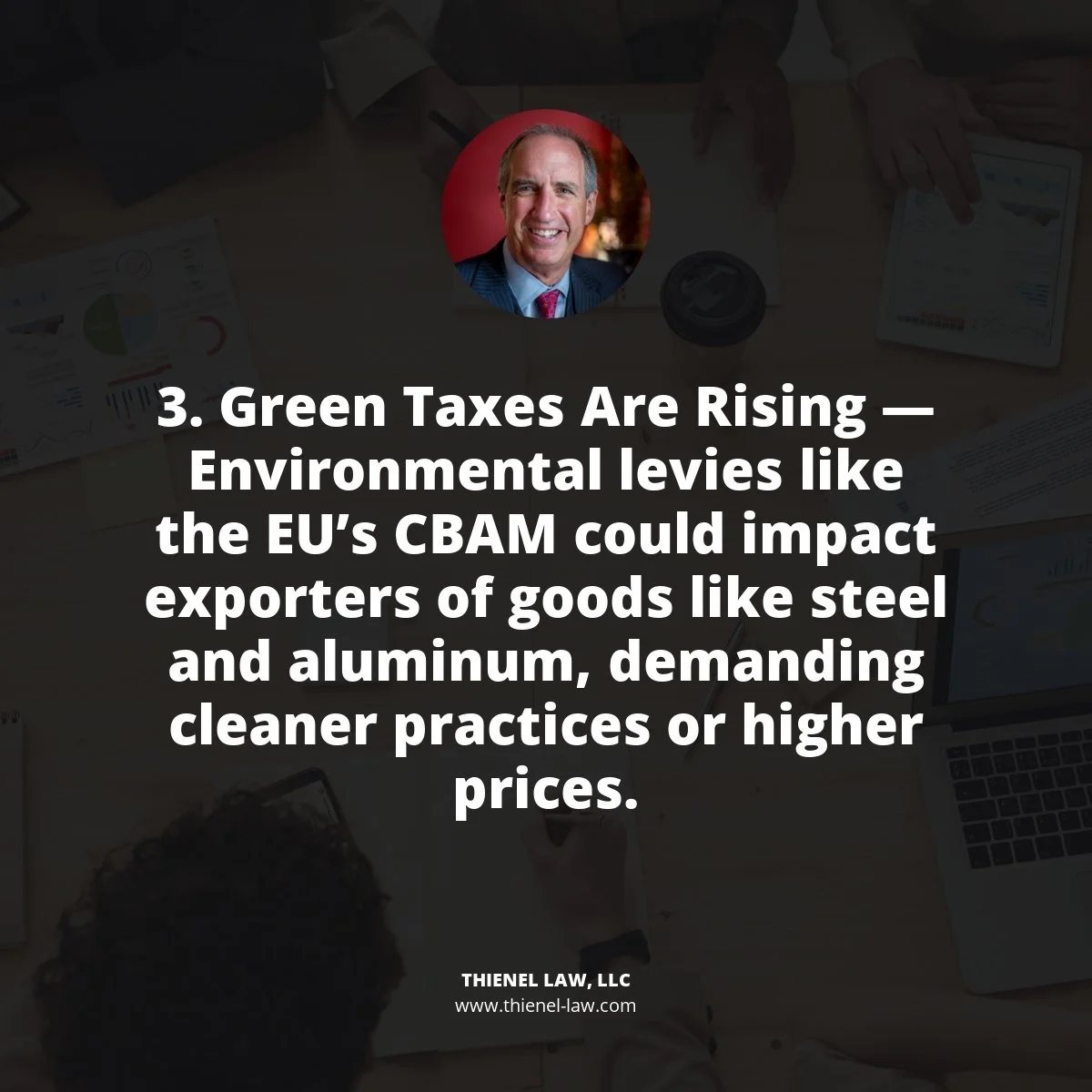
2. Green Tax Initiatives and Product Pricing
New green taxes are being rolled out across the EU to incentivize sustainable practices. The Carbon Border Adjustment Mechanism (CBAM), for example, essentially imposes a carbon price on imported goods that don't comply with EU environmental standards.
An American manufacturer exporting aluminum or steel to Europe may face these levies and will need to build the cost into pricing strategies—or consider production shifts. This trend could spread to other regions, influencing how companies manage their supply chains and logistics over the next decade.
3. Global Minimum Tax and Structuring Implications
Large multinational companies may also be affected by rules under the OECD's Pillar Two agreement, which establishes a minimum global corporate tax rate of 15%. Pillar Two rules are already being implemented across the EU and many other jurisdictions in 2025.
Even if the U.S. implementation is stalled, your international subsidiaries or holding structures could be affected. High-net-worth individuals with offshore accounts or trusts may also see increased reporting obligations and scrutiny.
4. Implications for Entity Selection and Compliance
Choosing between an LLC, partnership, or S-Corp has always required careful tax analysis. As other jurisdictions impose higher consumption or environmental taxes, cross-border transactions become harder to plan around.
For example, a technology startup in Virginia expanding operations to the EU via a partnership structure might face tax leakage through VAT and withholding rules that don't exist at the federal U.S. level. Proper structuring at the outset can make a significant difference.
Risk Management and Strategic Planning Tips
If your business has international elements—or plans to expand—you'll want to evaluate potential exposure to:
VAT registration and reporting obligations abroad
Green tax costs and ESG compliance requirements
Regulatory differences in new jurisdictions
International tax reporting such as FATCA, CRS, DAC6
Anti-avoidance rules across borders
As global tax systems shift toward digital and green revenue models, it's critical to include tax professionals in strategic decision-making. That means running supply chain analyses, staying current with treaty developments, and proactively filing where necessary.
Also consider aligning your entity structures, estate plans, and long-term goals with emerging global standards. For example, estate planning strategies involving offshore trusts or foreign real estate should be reviewed in light of growing international cooperation on transparency and reporting.
Looking Ahead: A More Connected Tax Environment
Perhaps the most forward-thinking insight from Dr. Mosquera Valderrama's interview is that global tax governance is now deeply intertwined with environmental, social, and technological change.
For decades, using offshore entities or arbitrage strategies to lower taxes was common practice. Now, governments—especially in the EU—are increasingly focused on accountability, sustainability, and fairness. Policies reflect this macro shift.
As a result, every business decision—whether it's expanding into a new market, launching digital products, or acquiring assets—should now include tax as a key factor, not an afterthought. This is true whether you're running a mid-sized business in Baltimore or managing a complex estate across borders.
What This Means for Your Business or Estate Plan
Let's bring this home with a few practical takeaways for clients in Maryland, Virginia, and D.C.:
Business Owners and Entrepreneurs
If you're offering services or selling goods to customers in the EU, it's time to ensure your tax setup accounts for VAT obligations and potential green levies. Don't wait for an audit.
Startups and Growing Companies
As you scale, your structure should be built to handle international growth. That might mean moving from an LLC to a C-Corp—or branching into the EU via the right kind of subsidiary.
High-Net-Worth Individuals
We recommend revisiting estate structures that include foreign assets, especially trusts, investment accounts, or businesses held abroad. The rules are continuing to shift toward stricter disclosure and uniform taxation.
International Clients
If you have interests on both sides of the Atlantic, from dual citizenships to vacation properties to offshore accounts, understanding both U.S. and EU tax dynamics will be essential for compliance and preservation.
Final Thoughts and Your Next Step
The EU tax mix is more than theory—it's already shaping how international business is done. And while the U.S. system differs in key ways, the global direction is clear: more visibility, more responsibility, and more policy tied to sustainability and fairness.
If you're unsure how this applies to your business or personal situation, we're here to help. Schedule a consultation with Steve Thienel to get advice tailored to your goals. Whether it's entity formation, cross-border compliance, or international estate planning, we can help you plan smart, stay compliant, and protect your interests.
Thienel Law: Strategic Counsel for Business and Tax Success
From Bethesda to Arlington to Washington, we serve clients who think beyond borders—and we help them thrive at every stage. Ready to move forward? Let's talk.

Steve Thienel, Esq.
Founder, Thienel Law, PLLC · Alexandria, Virginia
Steve Thienel is a business, tax, and estate planning attorney who represents clients throughout Maryland, Virginia, and Washington, D.C. He holds a J.D. from the University of Maryland and a Master of Laws (LL.M.) in Taxation from the University of Baltimore. Before practicing law full-time, Steve spent 24 years in senior leadership at CSX Corporation and served as adjunct faculty at Johns Hopkins University's MBA program for a decade, where he headed the economics department. He earned his M.A. in Economics from Virginia Tech, studying under Nobel Laureate James Buchanan.
Admitted to the Maryland, Virginia, and D.C. Bars · U.S. District Courts for the District of Columbia and District of Maryland